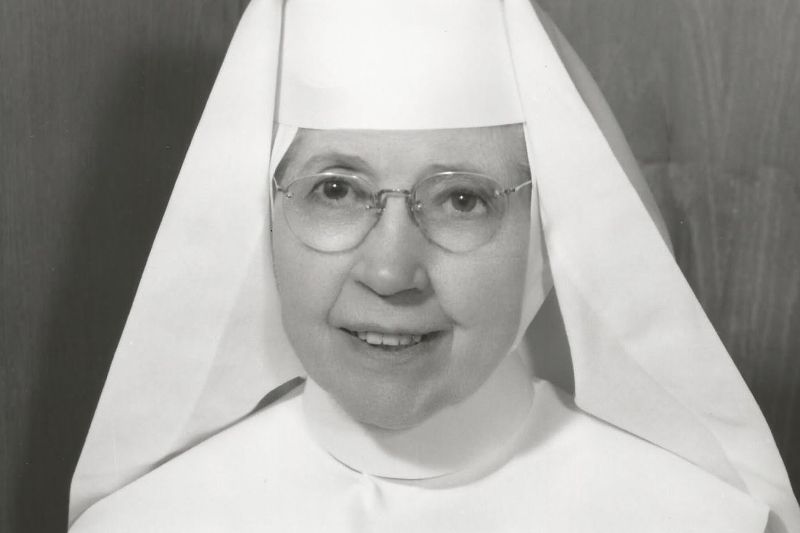
Sister Ignatia and Alcoholics Anonymous
1889 – 1966
Sisters of Charity of St. Augustine
The Drunk’s “Angel of Hope”
People who know the history of Alcoholics Anonymous have heard of Dr. Bob Smith and Bill Wilson, credited with founding the organization, but few have heard of the woman who shaped the hospital concept used to this day. On August 16, 1935, Sister Ignatia Gavin, a frail but no-nonsense Catholic sister in charge of admissions at St. Thomas Hospital in Akron, Ohio, with the help of Dr. Bob Smith, one of the founders of Alcoholics Anonymous, admitted the first alcoholic patient under the diagnosis of acute gastritis, thus making St. Thomas Hospital the first hospital in the world to treat alcoholism as a medical condition. Dr. Bob provided the medical treatment, while a steady stream of “reformed” alcoholics helped the man with his “spiritual” needs.
Although the hospital did not want to admit alcoholics, Sister Ignatia had previously circumvented the system. Sister Ignatia’s care for alcoholics started back in 1934, when she and emergency room intern, Thomas Scuderi, M.D., began secretly sobering alcoholics at the hospital, housing the alcoholism patient in the hospital’s flower room.
Sister Ignatia increasingly began to believe that alcoholics should not be sneaked into the hospital but brought through the front door just like other sick people.
This belief led to the first medical admission in 1935. Soon, she provided a ward for men to sober up and St. Thomas Hospital became the first religious institution to recognize the rights of alcoholics to receive hospital treatment. Today, many of AA’s practices — including the use of tokens to mark milestones in sobriety — find their origins with Sister Ignatia.
Sister lgnatia was the first person to use medallions in Alcoholics Anonymous. She gave the drunks who were leaving St. Thomas after a five day dry out a Sacred Heart Medallion and instructed them that the acceptance of the medallion signified a commitment to God, to A.A. and to recovery and that if they were going to drink, they had a responsibility to return the medallion to her before drinking. Click to see Sacred Heart Medallion. The custom is carried out to this day with tokens awarded for sobriety. The sacred heart medallions had been used prior to A.A. by the Father Matthew Temperance Movement of the 1840’s and the Pioneers, an Irish Temperance Movement of the 1890’s.
Dr. Bob died in 1950, and in 1952 Sister Ignatia was transferred to Cleveland’s St. Vincent Charity Hospital.
She recalled: “We’re just like people in the Army, you know. We go where we are sent. . . . I was there [in Akron] for 24 years. . . and finally the obedience came that I was to go to Charity and work with AA there.”
On August 7, 1952, at age 63, the “Angel of Alcoholics Anonymous” arrived in Cleveland for her new assignment. Planning began for an alcoholism wing at the hospital.
As part of the ward’s setup, Sister Ignatia requested a coffee bar for the patients, similar to the one in Akron. However, a board member who reviewed the plan questioned the need for it. He returned the plan to Sister Ignatia and said, “A table will have to do.” But. . . Ignatia would not compromise. She knew what she wanted for the AAs, and she put the future of the ward on the line with her reply: “Let’s forget about it if you’re not going to give us the proper setup.” The coffee bar remained in the drawings.
With the help and contributions of the many people Sister Ignatia had helped, Rosary Hall Solarium (its initials in memory of Dr. Bob, Robert Holbrook Smith) accepted its first patient on December 15. It was a kind of recovery mecca where physical medicine, spiritual nourishment, and brotherly love regularly produced miracles of recovery. . . . Sister Ignatia was Rosary Hall’s breath and spirit.
Through the years, the program successfully treated thousands of alcoholics. Sister Ignatia was among the first to acknowledge alcoholism among priests and nuns. She was also instrumental in implementing the first Al-Anon program, for families of alcoholics.
Even as her health declined, Sister Ignatia continued to care for alcoholics at Rosary Hall. Thousands of alcoholics knew first-hand Sister Ignatia’s honesty and nonjudgmental love.
For more than 30 years, Sister Mary Ignatia Gavin, CSA, founding both Ignatia Hall at St. Thomas in Akron and Rosary Hall Solarium at St. Vincent, was a messenger of hope for alcoholics and their families. Her courageous stand for medical treatment and her caring devotion to the victims of alcoholism helped Dr. Bob Smith and Bill Wilson, founders of Alcoholics Anonymous, and thousands who have come after them.
Sister Ignatia never accepted recognition for any of her work with alcoholics. Even in 1961, when she was recognized for her work by President Kennedy, gracious humility prevailed, accepting the awards only in the name of her religious community and profession.
Sister Ignatia retired in May 1965. She died less than a year later on April 1, 1966.